Security and Risk · Breach Management
Be ready for a personal data breach before one happens.
Controls that test your readiness to intimate a breach as the Rules require, and a log that follows each incident from detection to closure.
The problem
The plan is written during the incident
When a breach is discovered, the hours that matter are spent working out who decides, who must be told, and what the intimation has to say.
- Nobody has rehearsed intimating affected Data Principals.
- The information the Board must receive is not known in advance.
- Incidents are handled by security, and the privacy team hears later.
- There is no single record of what happened and what was done.
What it does
Breach Management in ControlMap
Breach readiness is assessed in the Privacy Framework module. A breach response control and four controls beneath it ask whether you can intimate affected Data Principals without delay, give the Board an initial description without delay, furnish the detailed report within seventy-two hours, and include the required contents in the intimation to Data Principals. Each is assessed with evidence.
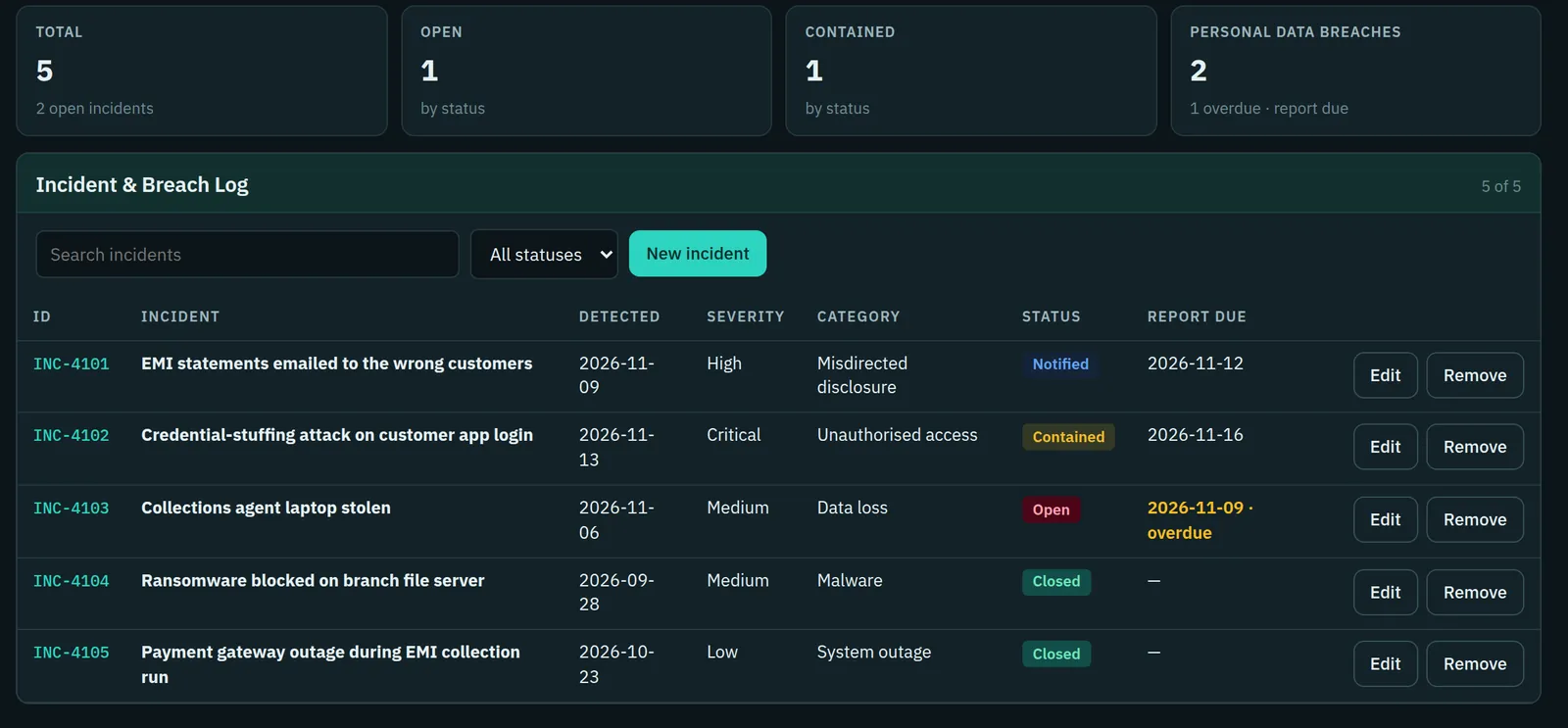
The Incident and Breach Log records what actually happens. Each incident has a detection date, severity, category and owner, whether personal data was involved, how many Data Principals were affected, the date the report to the Board is due, and the dates on which the Board and the Data Principals were told. Incidents move from open to contained, notified and closed.
Key capabilities
What you can do with it
Readiness controls
Five controls mapped to Section 8(6) and Rule 7, assessed for implementation and evidence.
Incident log
Detection date, severity, category, owner and a summary with root cause for every incident.
Personal data flag
Record whether personal data was involved, including unknown, and how many Data Principals were affected.
Report due date
Enter when the detailed report to the Board is due. Incidents past that date while still open are flagged.
Intimation dates
Record the dates the Board and the affected Data Principals were told.
Status counts
Open and contained incidents, and personal data breaches, counted on the summary.
In the product
The incident and breach log
Open incidents and personal data breaches, with their severity and due dates.
- Counts of open and contained incidents and of personal data breaches
- Detection date, severity, category and status for each incident
- The date a report is due, with overdue incidents flagged
Typical workflow
How teams use it
A common sequence. The product does not force the order, and you can return to the earlier steps as you learn more.
Assess readiness
Work through the breach controls and record evidence: the response plan, the intimation templates, the decision-makers.
Log the incident
When something is detected, record it with severity, category and owner.
Decide whether it is a personal data breach
Record whether personal data was involved and how many Data Principals are affected.
Intimate
Carry out the intimations through your own channels, and record the dates.
Close with a root cause
Record what happened and the measures taken to prevent recurrence.
DPDP governance
How it supports your obligations
Breach intimation is one of the most specific duties in the framework. The periods below are taken from Rule 7.
In the event of a personal data breach, the Data Fiduciary is to give the Board and each affected Data Principal intimation of the breach in the prescribed form and manner.
A parent control assesses whether a breach response process exists.
On becoming aware of a breach, the Data Fiduciary is to intimate each affected Data Principal without delay, in a concise, clear and plain manner, with a description of the breach, the likely consequences, the mitigation measures, the safety measures the person may take, and a contact.
Controls cover both the timing and the required contents of this intimation.
The Data Fiduciary is to intimate the Board without delay with a description of the breach, and within seventy-two hours of becoming aware of it, or a longer period the Board allows on written request, with detailed information.
Separate controls cover the initial intimation and the detailed report. The log records the due date and the date the Board was told.
Scope
What stays with you
We would rather you knew the boundaries before a demo than discovered them after.
- ControlMap does not detect incidents. They are logged by your team.
- It does not send intimations to Data Principals or submit reports to the Board.
- The report due date is entered by you. Calculate it from the time your organisation became aware of the breach.
- The log is a register. It does not feed readiness scores.
Questions
Breach Management: common questions
Does ControlMap report a breach to the Data Protection Board?
No. Your organisation makes the intimation through the means the Board provides. ControlMap helps you prepare, and records what was done and when.
Is every security incident a personal data breach?
No. The Act defines a personal data breach as unauthorised processing, or accidental disclosure, acquisition, sharing, use, alteration, destruction or loss of access to personal data, that compromises its confidentiality, integrity or availability. The log lets you record incidents of both kinds and mark which involved personal data.
Is there a threshold below which a breach need not be intimated?
Section 8(6) and Rule 7 do not state a materiality threshold. Take advice on how they apply to a particular incident.
See Breach Management in a demo.
We will show the module with the product's sample data and answer what it does and does not cover.