Compliance Management · DPIA
Keep Data Protection Impact Assessments on schedule and evidenced.
For Significant Data Fiduciaries: designation status, the DPIA and audit cycle, the people responsible, and findings when something is missing or overdue.
The problem
A recurring obligation with no calendar
A Data Protection Impact Assessment that must be repeated every twelve months is easy to complete once and hard to keep completing.
- Nobody owns the next assessment after the first one is filed.
- The date of the last DPIA is in a document, not on a schedule.
- It is unclear whether the organisation is a Significant Data Fiduciary at all.
- The DPO's and auditor's details are not recorded anywhere official.
What it does
DPIA in ControlMap
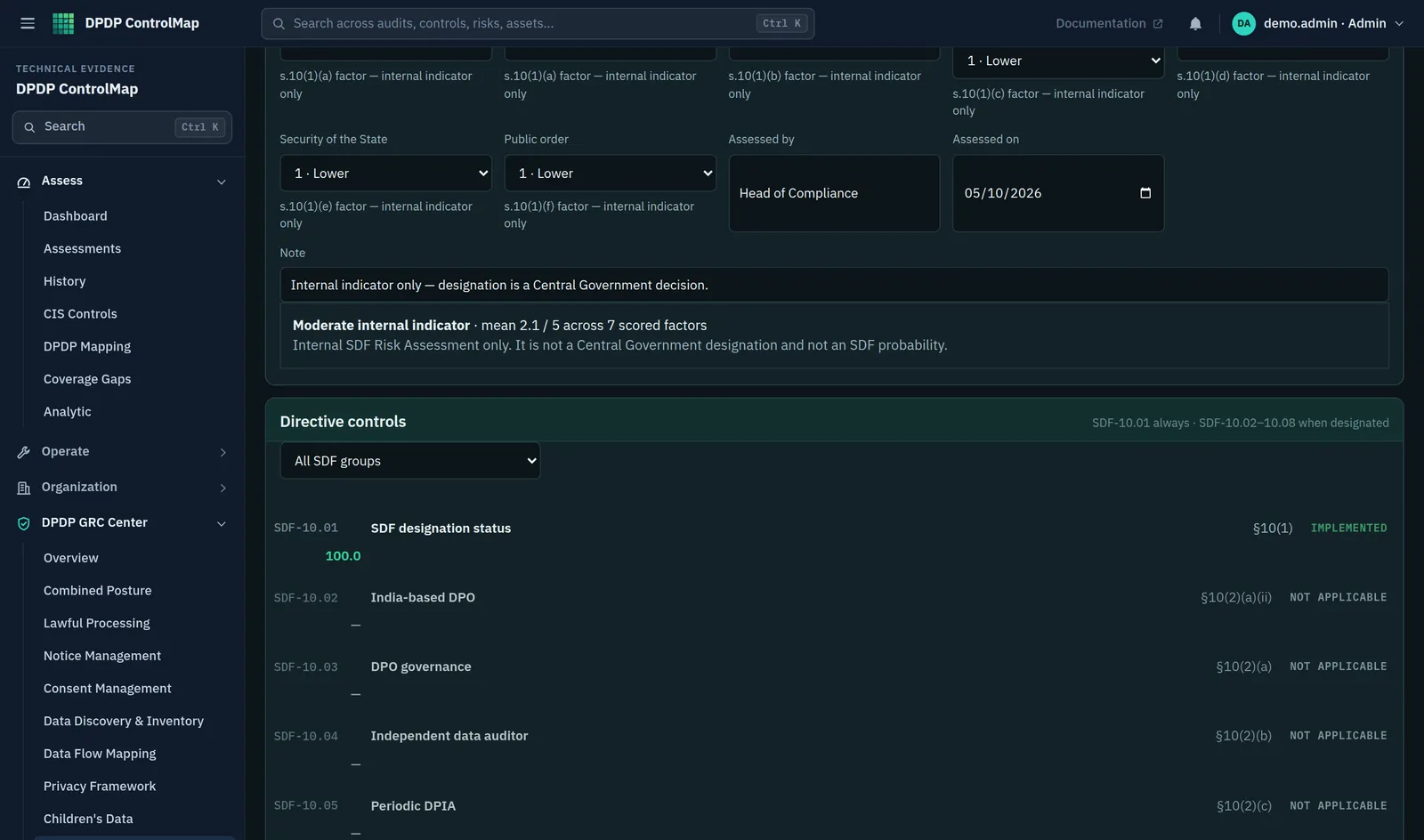
The SDF, DPIA and Audit module records whether your organisation has been notified as a Significant Data Fiduciary, with the notification reference and date. It will not let a score or an internal view stand in for that designation: status is recorded as not designated, designated or under assessment.
For designated organisations it holds the Data Protection Officer's record, the independent data auditor's record, and a recurring schedule each for the DPIA and the audit, with the last completion, the next due date, the cadence, an owner and a note of the evidence. Missing and overdue items are raised as findings, and eight controls assess the obligations.
Key capabilities
What you can do with it
Designation status
Not designated, designated or under assessment, with the notification reference and who recorded it.
DPIA schedule
Last completed, next due, cadence in months, owner and evidence note.
Audit schedule
The same recurring record for the independent audit.
DPO and auditor records
Who holds each role, whether the DPO is based in India, and whether the details are published.
Internal risk view
A structured internal assessment against the factors in Section 10(1), kept separate from designation.
Findings
Raised automatically for an unknown DPO, a DPO not based in India, an unknown auditor, a missing schedule or an overdue DPIA or audit.
In the product
The SDF controls
Each obligation with its reference in the Act and its current status.
- Designation status, India-based DPO and independent data auditor
- Periodic DPIA and periodic audit as separate controls
- The Act reference beside each control
Typical workflow
How teams use it
A common sequence. The product does not force the order, and you can return to the earlier steps as you learn more.
Record your status
Enter whether the organisation has been notified as a Significant Data Fiduciary, with the reference.
Record the roles
Add the DPO and the independent data auditor.
Set the schedules
Enter the last DPIA and audit, the cadence and the owner. The next due date follows.
Carry out the assessment
Conduct the DPIA with your own method and advisers, then record completion and where the report is held.
Assess the controls
Assess the eight SDF controls with evidence, and clear the findings.
DPDP governance
How it supports your obligations
These obligations apply only to Data Fiduciaries notified by the Central Government as Significant Data Fiduciaries.
The Central Government may notify a Data Fiduciary or class of Data Fiduciaries as Significant Data Fiduciary on an assessment of factors including the volume and sensitivity of personal data processed and the risk to the rights of Data Principals.
Status is recorded from the notification. The internal risk view uses the same factors and is labelled as internal.
A Significant Data Fiduciary is to appoint a Data Protection Officer who is based in India, responsible to the board of directors or similar governing body, and the point of contact for grievance redressal.
The DPO record captures these points, and gaps are raised as findings.
A Significant Data Fiduciary is to undertake a periodic Data Protection Impact Assessment and periodic audit; under Rule 13, once in every period of twelve months.
Both are tracked on recurring schedules with owners and due dates.
Scope
What stays with you
We would rather you knew the boundaries before a demo than discovered them after.
- ControlMap does not contain a DPIA questionnaire or generate a DPIA report. The assessment is carried out with your own method.
- Whether an organisation is a Significant Data Fiduciary is decided by Central Government notification. The internal risk view does not determine it.
- The product does not furnish reports to the Board.
Questions
DPIA: common questions
Do we need a DPIA if we are not a Significant Data Fiduciary?
The Act places the DPIA requirement on Significant Data Fiduciaries. Other organisations sometimes carry out impact assessments voluntarily for high-risk processing. ControlMap's schedule can be used for that, and the product will not treat it as an SDF obligation.
Does ControlMap tell us whether we are a Significant Data Fiduciary?
No. Designation is by notification of the Central Government under Section 10. The module offers an internal assessment against the Section 10(1) factors to help you prepare, and labels it as an internal review.
Where is the DPIA report stored?
In your own document system. ControlMap records that the assessment was completed, when, by whom, and where the report can be found.
See DPIA in a demo.
We will show the module with the product's sample data and answer what it does and does not cover.