Security and Risk · Processor Oversight
Keep your Data Processors, and what they hold, in view.
Processor controls from Section 8, processors identified on every dataset and data flow, and a register of vendors with contract references and assessment dates.
The problem
Responsibility stays with you. Visibility often does not.
A Data Fiduciary answers for what its processors do. Yet the list of processors is usually held by procurement, and the privacy team learns of a new one after the contract is signed.
- There is no complete list of who processes personal data on your behalf.
- Contracts do not address security safeguards or erasure.
- Processors are assessed at onboarding and not again.
- Nobody knows which processors hold which data, or where.
What it does
Processor Oversight in ControlMap
Processors appear in three places in ControlMap. The Privacy Framework module assesses the processor duties in Section 8: a valid contract, the fiduciary's responsibility for processing on its behalf, security safeguards in the contract, and causing the processor to erase data. The inventory and the flow register record the processor for each dataset and each flow, and raise a finding where a flow's processor is unknown.
The vendor register holds the commercial record: the service provided, a risk tier, the country, the data categories handled, the contract or data processing agreement reference, an owner, and the dates of the last and next assessment. Vendors move through onboarding, active, under review and offboarded.
Key capabilities
What you can do with it
Processor governance controls
Controls for a valid processor contract and for the fiduciary's responsibility for processing on its behalf.
Security in the contract
A control for including reasonable security safeguards in the processor contract, as Rule 6 lists.
Erasure by processors
A control for causing processors to erase personal data when its purpose is served.
Processor on every record
The inventory and the flow register both name the processor, and unknown processors on flows are raised as findings.
Vendor register
Service, risk tier, country, data categories, contract reference and owner for each third party.
Assessment schedule
Last and next assessment dates, with overdue assessments flagged.
In the product
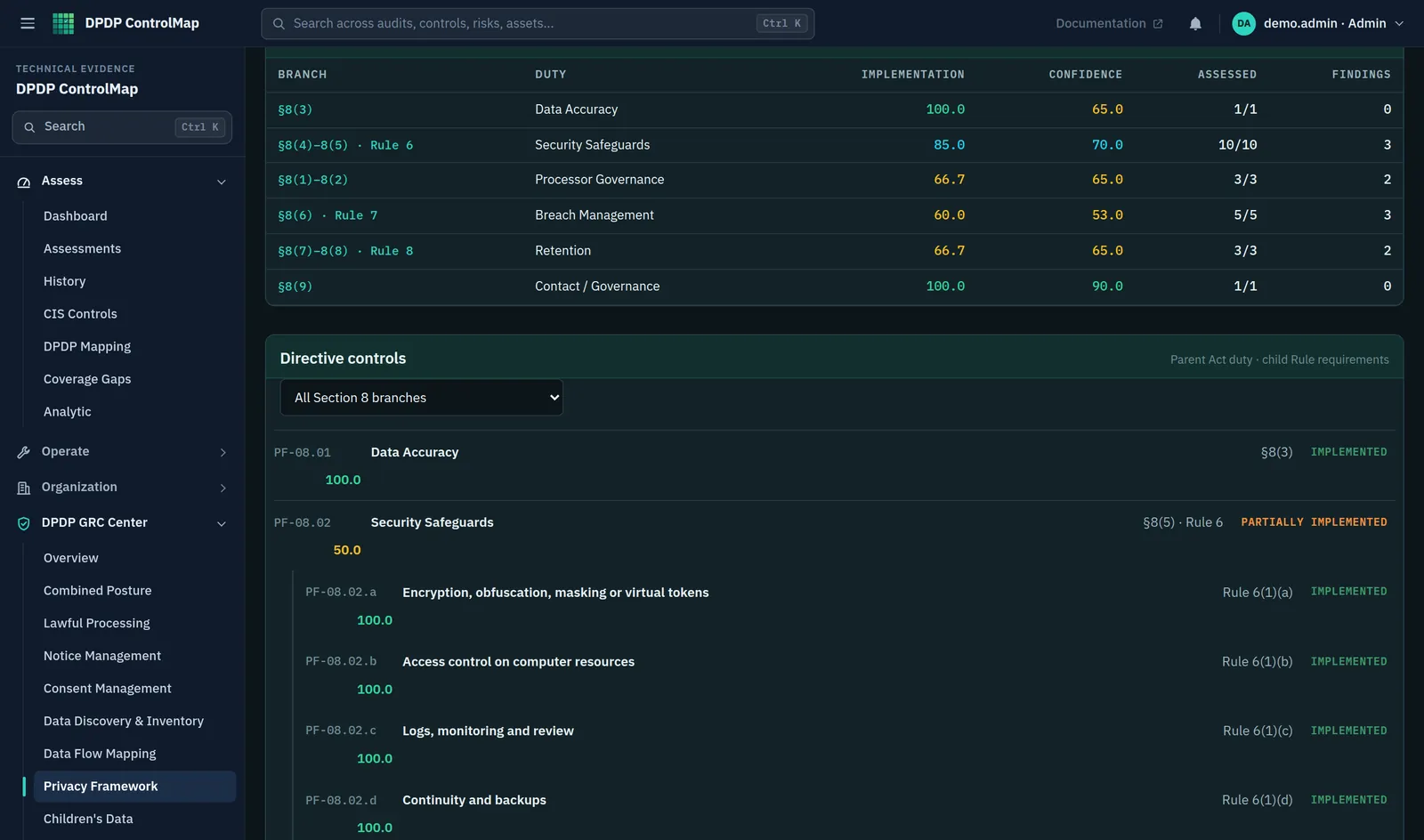
Processor governance in the Privacy Framework
The Section 8 duties, including processor governance, with implementation and confidence scored separately.
- Processor Governance as one of six duty areas under Section 8
- Implementation and confidence shown as separate figures
- The Rule 6 safeguards listed as individual controls
Typical workflow
How teams use it
A common sequence. The product does not force the order, and you can return to the earlier steps as you learn more.
List your processors
Start from the flow map: every node in the processor lane is a processor to account for.
Record each in the vendor register
Add the service, the data categories, the country and the contract reference.
Check the contract
Confirm there is a valid contract and that it addresses security safeguards and erasure.
Assess the controls
Assess the processor controls in the Privacy Framework with evidence.
Reassess on schedule
Set the next assessment date by risk tier and keep to it.
DPDP governance
How it supports your obligations
The Act places these duties on the Data Fiduciary. A Data Processor's obligations reach it through the contract.
A Data Fiduciary is responsible for complying with the Act and Rules in respect of any processing undertaken by it or on its behalf by a Data Processor, irrespective of any agreement to the contrary.
A control assesses how the fiduciary discharges that responsibility for each processor.
A Data Fiduciary may engage a Data Processor to process personal data on its behalf only under a valid contract.
A control assesses whether a valid contract exists, and the vendor register holds the reference.
Reasonable security safeguards include appropriate provision in the contract between the Data Fiduciary and the Data Processor for taking reasonable security safeguards.
A dedicated control covers this provision.
On withdrawal of consent or when the specified purpose is no longer served, the Data Fiduciary is to erase personal data and cause its Data Processor to erase any personal data made available to it.
A control assesses whether erasure is passed on to processors.
Scope
What stays with you
We would rather you knew the boundaries before a demo than discovered them after.
- ControlMap does not send questionnaires to vendors or collect their responses.
- It does not store contracts. The register holds the reference.
- The vendor register is a record. It does not feed readiness scores; the processor controls in the Privacy Framework do.
Questions
Processor Oversight: common questions
We are a Data Processor. Is this module for us?
It is written for Data Fiduciaries overseeing processors. If you process on behalf of others, see the Data Processors solution page, which explains how ControlMap helps you evidence what your customers' contracts ask of you.
Does a processor have direct obligations under the Act?
The Act places its principal obligations on the Data Fiduciary, which remains responsible for processing done on its behalf. What a processor must do is set largely by its contract. Take advice on your specific position.
Can vendors fill in assessments themselves?
Not in the product today. Your team records the outcome of each assessment.
See Processor Oversight in a demo.
We will show the module with the product's sample data and answer what it does and does not cover.