By sector · Education
Student records and verifiable parental consent
Most students are children under the Act, which sets additional duties for their data. ControlMap records where student data is held, how consent is obtained and who else receives it.
Your role under the Act
Institutions are usually Data Fiduciaries; platform suppliers vary
A school, college or training provider that decides why and how student data is processed is a Data Fiduciary. A supplier that runs a platform on the institution's behalf may be its Data Processor.
A provider that offers its own service directly to students and decides how their data is used is a Data Fiduciary in its own right, with the duties that follow.
Challenges
What makes this hard
Most Data Principals are children
The Act defines a child as an individual who has not completed eighteen years, which covers nearly every school student.
Consent through parents
Admissions, apps and activities all need a reliable way to identify the parent and record their consent.
Many platforms
Learning, assessment, communication and fee platforms each receive student data, often arranged by individual departments.
Monitoring and safety
Attendance, transport tracking and cameras serve safety, and need to stay within the purposes the Rules allow.
Records kept after students leave
Alumni and former applicant data accumulates without a retention decision.
Staff data as well
The institution is also an employer, with its own obligations for employee data.
Relevant DPDP obligations
What the Act and the Rules say
These provisions are often relevant to education. They are summaries; the full list is on the DPDP Act page.
Verifiable parental consent
Before processing a child's personal data, a Data Fiduciary obtains the verifiable consent of the parent, and observes due diligence to check that the person identifying as the parent is an identifiable adult.
No detrimental processing
A Data Fiduciary does not undertake processing that is likely to cause any detrimental effect on the well-being of a child.
No tracking or targeted advertising
A Data Fiduciary does not undertake tracking or behavioural monitoring of children, or targeted advertising directed at children.
Limited exceptions for educational institutions
Sections 9(1) and 9(3) do not apply to an educational institution where processing is restricted to tracking and behavioural monitoring for its educational activities or in the interests of the safety of enrolled children. Outside those conditions the duties apply.
A notice parents can understand
The notice is to be understandable on its own and to itemise the personal data and the specified purpose in clear and plain language.
Erasure when the purpose ends
Personal data is erased when consent is withdrawn or as soon as it is reasonable to assume the specified purpose is no longer being served, unless retention is necessary to comply with a law.
Typical workflow
How the work usually runs
A sequence that follows the student from admission onwards.
Inventory student data
Record admission, academic, health, transport and fee data, with the system and owner for each.
Mark children's data
Flag the datasets that hold data about students under eighteen so the Section 9 controls are assessed.
Record how parental consent is verified
ControlMap holds the record and assesses the control. The verification itself happens in your admission or sign-up process.
Review each platform
List the suppliers that receive student data, whether each is a processor, and what the contract says.
Decide retention
Set a retention period for each dataset, including data about former students and applicants.
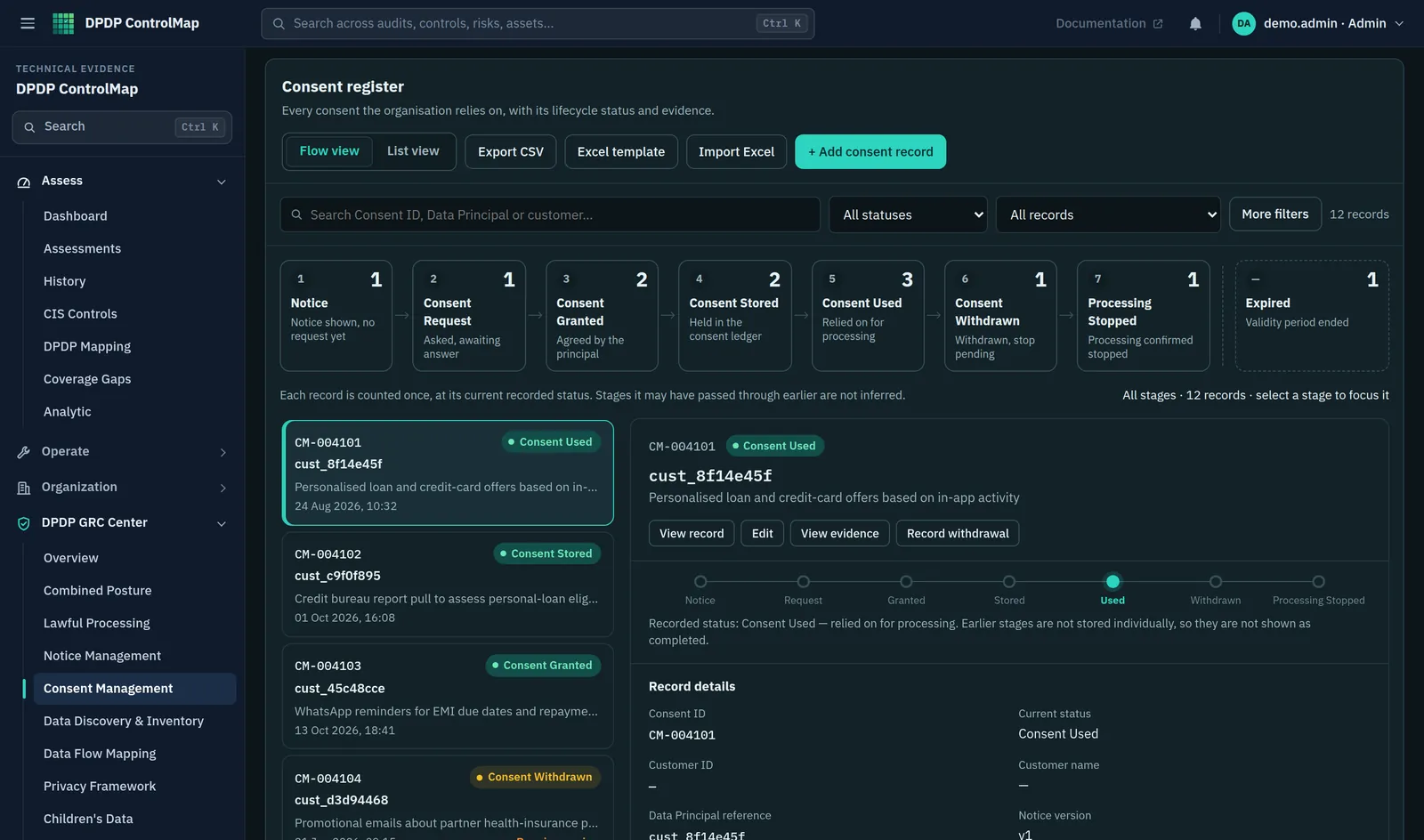
Recommended modules
A suggested place to begin
A suggested starting set. Every module shares the same inventory and control catalogue, so others can be added when you need them.
- Consent ManagementConsent records with their purpose, notice version and withdrawal.
- Privacy NoticesNotices for parents and students, versioned and reviewed.
- Data InventoryStudent and staff data recorded by system and owner.
- Data ClassificationChildren's data labelled consistently.
- Processor OversightPlatform suppliers, contracts and their safeguards.
Implementation approach
Three phases, in your own time
The order matters more than the pace. How long each phase takes depends on how many systems you have and who is available to do the work.
- First
Admission and core records
Inventory the admission and student record systems, and review the notice and consent taken at admission.
- Next
Platforms and monitoring
Review each platform and any tracking or monitoring against Section 9 and the Fourth Schedule.
- Ongoing
Each academic year
Revisit the record when platforms change, and act on retention for students who have left.
Benefits
What you have at the end
ControlMap supports the work of governance. Meeting the Act's requirements remains the responsibility of your organisation.
- A clear record of where student data is held and who receives it.
- Children's data is identified, so the right controls are assessed against it.
- Monitoring purposes are written down and reviewable.
- Retention decisions exist for former students and applicants.
See how ControlMap handles student data.
We will walk through the modules on this page with the product's sample data and answer what they do and do not cover.