Data Governance · Records of Processing
Keep a record of what you process, why, and on what basis.
Purpose and lawful basis documented for each processing activity, with the inventory, flows and notices that complete the record held in the same workspace.
The problem
The basis for processing is rarely written down
Teams know what they do with personal data. Few have recorded why it is lawful, activity by activity, in a form that could be shown to someone else.
- Consent is assumed where a legitimate use applies, and the reverse.
- Purposes are described differently in the notice, the contract and the system.
- Processing continues after the original purpose has ended.
- When asked to demonstrate the basis, the answer has to be reconstructed.
What it does
Records of Processing in ControlMap
ControlMap holds the components of a record of processing in connected modules. Lawful Processing assesses, with evidence, whether each activity has a documented purpose and an identified basis under Section 4 or Section 7. The inventory records the purpose, basis, retention, location and processor for each dataset. Flows record recipients. Each notice version is linked to the processing activity it covers.
The DPDP Act does not prescribe a record of processing activities by that name, and ControlMap does not generate a single consolidated register document. What it gives you is the underlying record, kept current, from which that register can be assembled and evidenced.
Key capabilities
What you can do with it
Purpose controls
Controls for documenting the purpose of processing and linking each activity to a specific purpose.
Lawful basis controls
A control for identifying whether each activity relies on consent or a legitimate use.
Legitimate use assessment
Four controls for Section 7: documenting the use, assessing its conditions, staying within the purpose and maintaining records.
Purpose and basis on the inventory
Every dataset record states its purpose and processing basis.
Recipients from flows
Processors and other recipients are recorded in the flow register.
Notice linked to activity
Each notice version names the processing activity it relates to.
In the product
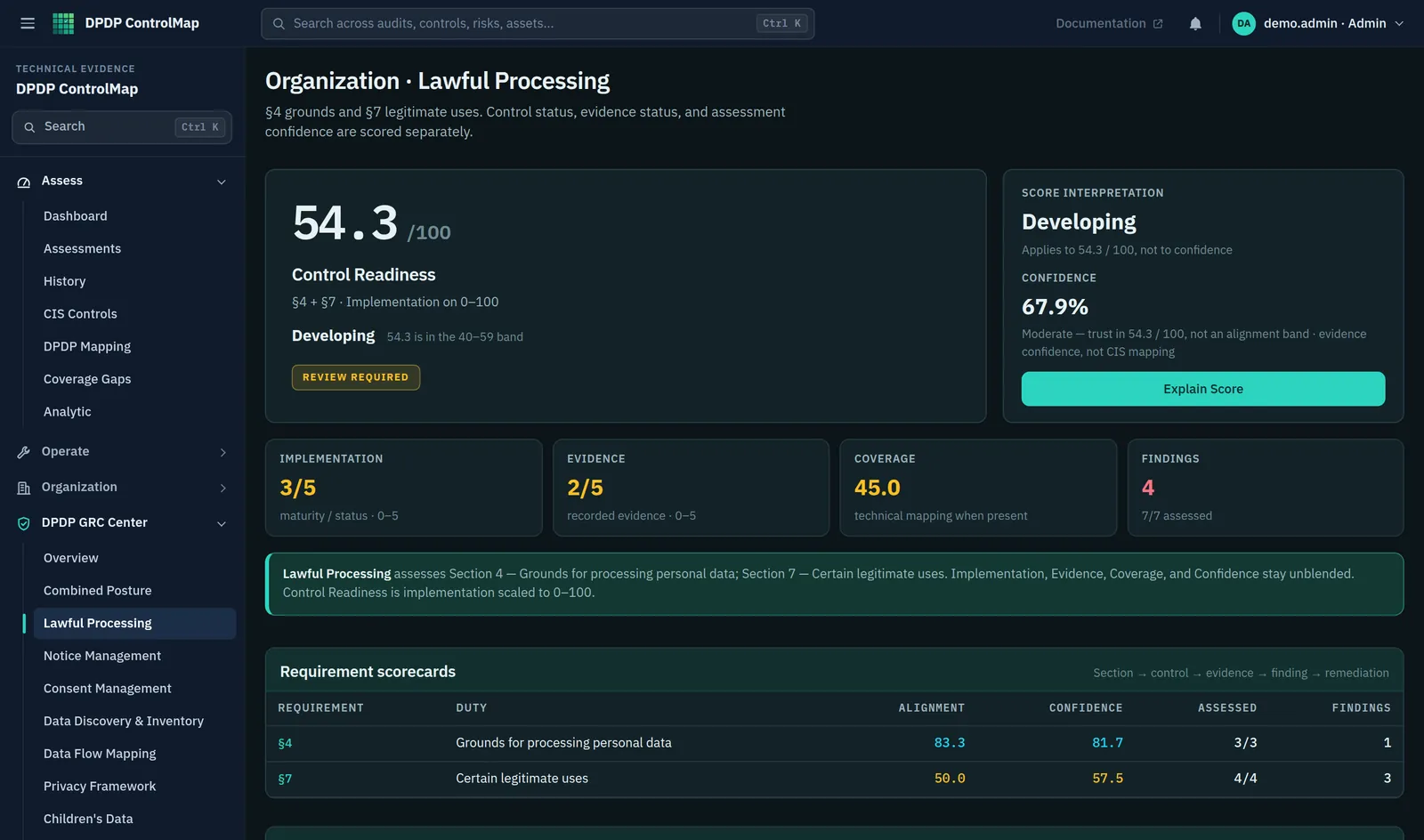
The Lawful Processing module
Readiness for Section 4 and Section 7, with implementation and evidence shown separately.
- A scorecard for grounds for processing and for certain legitimate uses
- Implementation, evidence, coverage and findings as separate figures
- Each control opens to its assessment, evidence and owner
Typical workflow
How teams use it
A common sequence. The product does not force the order, and you can return to the earlier steps as you learn more.
List processing activities
Name each activity in business terms: payroll, customer onboarding, marketing email.
State the purpose
One specific purpose for each activity, in the words the notice uses.
Identify the basis
Consent, or the clause of Section 7 relied on, with the reasoning.
Connect the record
Check that the inventory, the flows and the notice describe the same activity in the same way.
Assess and evidence
Assess the Lawful Processing controls and attach the evidence.
DPDP governance
How it supports your obligations
The provisions below are why a record of processing is worth keeping, even though the Act does not name one.
A person may process personal data only in accordance with the Act and for a lawful purpose, for which the Data Principal has given consent or for certain legitimate uses.
Purpose and basis are documented and assessed for each activity.
Personal data may be processed for certain legitimate uses listed in the section, including where the Data Principal has voluntarily provided it for a specified purpose, and for employment-related purposes.
Reliance on a legitimate use is documented, and its conditions are assessed.
Where consent is the basis and a question arises in a proceeding, the Data Fiduciary is to prove that a notice was given and consent was given in accordance with the Act.
The record connects each activity to the notice version and to consent evidence.
Scope
What stays with you
We would rather you knew the boundaries before a demo than discovered them after.
- There is no single exportable register of processing activities in the product today.
- Choosing the correct basis for an activity is a legal judgement. ControlMap records the decision and its evidence. It does not make it.
Questions
Records of Processing: common questions
Does the DPDP Act require a RoPA?
Not by that name. The term comes from the European Union's GDPR. The DPDP Act requires processing to have a lawful purpose and a basis, and places the burden of proving consent on the Data Fiduciary. Many organisations keep a record of processing because it is the practical way to meet those requirements.
Can ControlMap export a RoPA document?
Not as one document today. The inventory, flows, notices and lawful-processing assessments hold the content, and the notice and consent registers export as CSV. The PDF reports in the product cover technical readiness.
We already have a GDPR RoPA. Can we use it?
It is a good starting point. The lawful bases differ: the DPDP Act provides consent and certain legitimate uses, and has no general legitimate-interests basis. Each activity needs to be reviewed against Sections 4 and 7.
See Records of Processing in a demo.
We will show the module with the product's sample data and answer what it does and does not cover.