By role under the Act · Data Processors

For organisations that process personal data on a fiduciary's behalf

The Act addresses its obligations to the Data Fiduciary, which then has to make sure its processors can meet them. ControlMap helps a processor show what it has in place.

Your role under the Act

A different role, with different duties

A Data Processor is any person who processes personal data on behalf of a Data Fiduciary (Section 2(k)). The Act addresses the obligations in Chapter II to the Data Fiduciary, which may engage a processor only under a valid contract (Section 8(2)).

Much of what a processor has to do therefore reaches it through that contract. A processor is also a Data Fiduciary for data it controls itself, such as its own employees' data.

ControlMap's catalogue is written from the Data Fiduciary's point of view. A processor uses it to record the safeguards its customers ask about and to manage its own fiduciary duties.

Guide: Data Fiduciary or Data Processor

Data Fiduciary

Section 2(i) Any person who alone or in conjunction with other persons determines the purpose and means of processing of personal data.

  • Answers for processing done by it or on its behalf by a Data Processor (Section 8(1)).
  • Gives notice and obtains consent, or relies on a certain legitimate use (Sections 4 to 7).
  • Takes reasonable security safeguards and intimates breaches (Sections 8(5) and 8(6)).
  • Responds to the rights and grievances of Data Principals (Sections 11 to 14).
Data Processor

Section 2(k) Any person who processes personal data on behalf of a Data Fiduciary.

  • Is engaged by a Data Fiduciary only under a valid contract (Section 8(2)).
  • Meets most of its duties through that contract; Chapter II is addressed to the fiduciary.
  • Has to be able to stop processing and erase data when the fiduciary is required to cause it (Sections 6(6) and 8(7)).
  • Is itself a Data Fiduciary for data it controls, such as its own employees' data.

Which role an organisation holds depends on the facts of each processing activity, and one organisation can hold both. If the answer is unclear, take legal advice.

Challenges

What makes this hard

  • A different questionnaire from every customer

    Each fiduciary asks about the same safeguards in its own format, and each answer is written afresh.

  • Instructions that must be acted on

    When a fiduciary's customer withdraws consent, the fiduciary has to cause its processors to stop and to erase.

  • Sub-processors

    Hosting and tooling suppliers sit behind the service, and customers expect them to be known and controlled.

  • Evidence on request

    Customers want to see proof of access control, logging and backups, not a statement that they exist.

  • Incidents that start a customer's clock

    A fiduciary's time to intimate the Board runs from when it becomes aware, so it needs to hear quickly.

  • Two roles in one organisation

    The same company is a processor for customer data and a fiduciary for its own staff and prospects.

Relevant DPDP obligations

What the Act and the Rules say

What the Act and the Rules say about processing by a Data Processor, in summary. In each case the duty is placed on the Data Fiduciary; the processor meets it in practice through the contract.

Section 8(2)

Engagement only under a valid contract

A Data Fiduciary may engage a Data Processor to process personal data on its behalf only under a valid contract.

Section 8(5) · Rule 6(1)(f)

Safeguards written into the contract

The fiduciary's duty to take reasonable security safeguards covers processing by its processors, and the Rules call for appropriate provision in the contract for taking those safeguards.

Section 6(6)

Stopping when consent is withdrawn

On withdrawal, the Data Fiduciary is to cease, and cause its Data Processors to cease, processing within a reasonable time, unless processing without consent is required or authorised by law.

Section 8(7)(b)

Erasure at the processor

The Data Fiduciary is to cause its Data Processor to erase personal data that it made available for processing, unless retention is necessary for compliance with a law.

Rule 8(3)

Retention of data and logs

For processing undertaken by it or on its behalf by a Data Processor, the Data Fiduciary retains personal data, associated traffic data and other logs for a minimum of one year for the purposes in the Seventh Schedule.

Section 8(6) · Rule 7

Breach intimation by the fiduciary

The Data Fiduciary intimates the Board and affected Data Principals. To do so in time it depends on prompt notice from the processor, which is normally a contract term and not a statutory duty on the processor.

These are summaries for orientation, not legal advice. Whether a provision applies to you depends on your facts. The DPDP Act page sets out the provisions more fully, says when each comes into force and links to the official text.

Typical workflow

How the work usually runs

A sequence for a processor preparing to answer its customers.

  1. Record the data you process for customers

    List the datasets handled for each service, where they are stored and who is responsible.

  2. Assess the safeguards

    Work through the security safeguard controls drawn from Rule 6 and record the evidence for each.

  3. List your own processors

    Record hosting and tooling suppliers, the data they receive and the contract reference.

  4. Prepare for instructions and incidents

    Record how a request to stop or erase is carried out, and how a customer is told of an incident.

  5. Cover your own fiduciary data

    Assess the controls for employee and prospect data, where the obligations are yours directly.

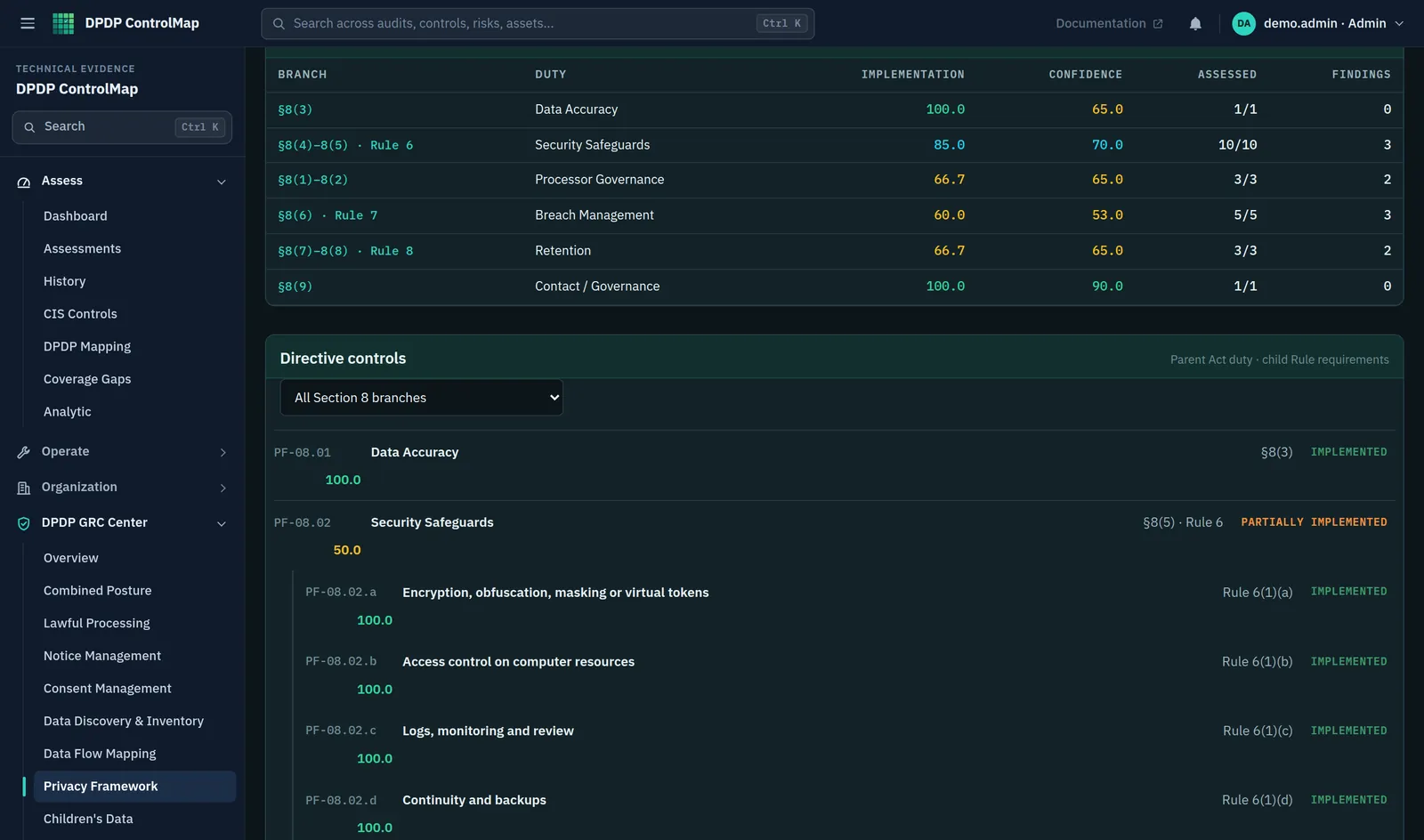
The Privacy Framework module: Section 8 duties for data accuracy, security safeguards, processor governance, breach management, retention and contact, each with implementation and confidence scores, followed by controls for the Rule 6 safeguards.
Product screenshot. The organisation and records shown are sample data that ships with ControlMap.

Implementation approach

Three phases, in your own time

The order matters more than the pace. How long each phase takes depends on how many systems you have and who is available to do the work.

  1. First

    Record services and safeguards

    Inventory the data processed for customers and assess the security safeguard controls.

  2. Next

    Sub-processors and instructions

    Review supplier contracts, and document how stop, erase and incident instructions are handled.

  3. Ongoing

    Maintain for each customer review

    Keep assessments and evidence current, so each customer review starts from an up-to-date record.

Benefits

What you have at the end

ControlMap supports the work of governance. Meeting the Act's requirements remains the responsibility of your organisation.

  • One maintained record to answer customer questionnaires from.
  • Safeguards assessed against the list in Rule 6, with evidence attached.
  • Sub-processors and their contracts kept in view.
  • Your duties as a fiduciary and your commitments as a processor recorded separately.

See what you could show your customers.

We will walk through the modules on this page with the product's sample data and answer what they do and do not cover.