By organisation · NGOs and non-profits
Beneficiary and donor data, handled with care
Non-profits hold data about people in vulnerable circumstances, often collected in the field and shared with partners. ControlMap gives a small team one record of what is held and why.
Your role under the Act
Usually a Data Fiduciary for programme data
An organisation that collects beneficiary, donor, volunteer or staff data and decides how it is used is a Data Fiduciary. The Act does not set a general exemption for non-profit organisations.
Where an organisation handles data for a funder or a public programme strictly on their instructions, it may be acting as a Data Processor for that activity. The answer depends on who decides the purpose and means in each case.
Challenges
What makes this hard
Data collected in the field
Forms are filled on paper and phones, then typed into spreadsheets. The Act applies once that data is in digital form.
Children among beneficiaries
Many programmes serve people under eighteen, for whom the Act sets additional duties.
Sharing with funders and partners
Reports to donors, government programmes and implementing partners carry personal data, often by email.
Volunteers and turnover
People who collect and handle data change often, and knowledge of what is held leaves with them.
Records kept indefinitely
Old programme data stays in drives long after the purpose it was collected for has ended.
A small team
There is rarely a dedicated privacy or IT security role.
Relevant DPDP obligations
What the Act and the Rules say
These provisions are often relevant to programme work. They are summaries; the full list is on the DPDP Act page.
Paper records that are digitised
The Act applies to personal data collected in digital form, and to data collected in non-digital form and digitised subsequently.
Notice and consent in a language people read
The Data Principal is to have the option to access the notice and the request for consent in English or any language specified in the Eighth Schedule to the Constitution.
Children's data
Before processing a child's personal data, a Data Fiduciary obtains the verifiable consent of the parent. It does not undertake tracking, behavioural monitoring or targeted advertising directed at children. Rule 12 and the Fourth Schedule set limited exceptions.
Persons with disability who have a lawful guardian
Verifiable consent is obtained from the lawful guardian, with due diligence to verify the guardian's appointment.
Erasure when the purpose ends
Personal data is erased when consent is withdrawn or as soon as it is reasonable to assume the specified purpose is no longer being served, unless retention is necessary to comply with a law.
Research, archiving and statistics
The Act does not apply to processing necessary for research, archiving or statistical purposes where the data is not used to take a decision specific to a Data Principal and the standards in the Second Schedule are followed.
Typical workflow
How the work usually runs
A sequence that suits programme teams.
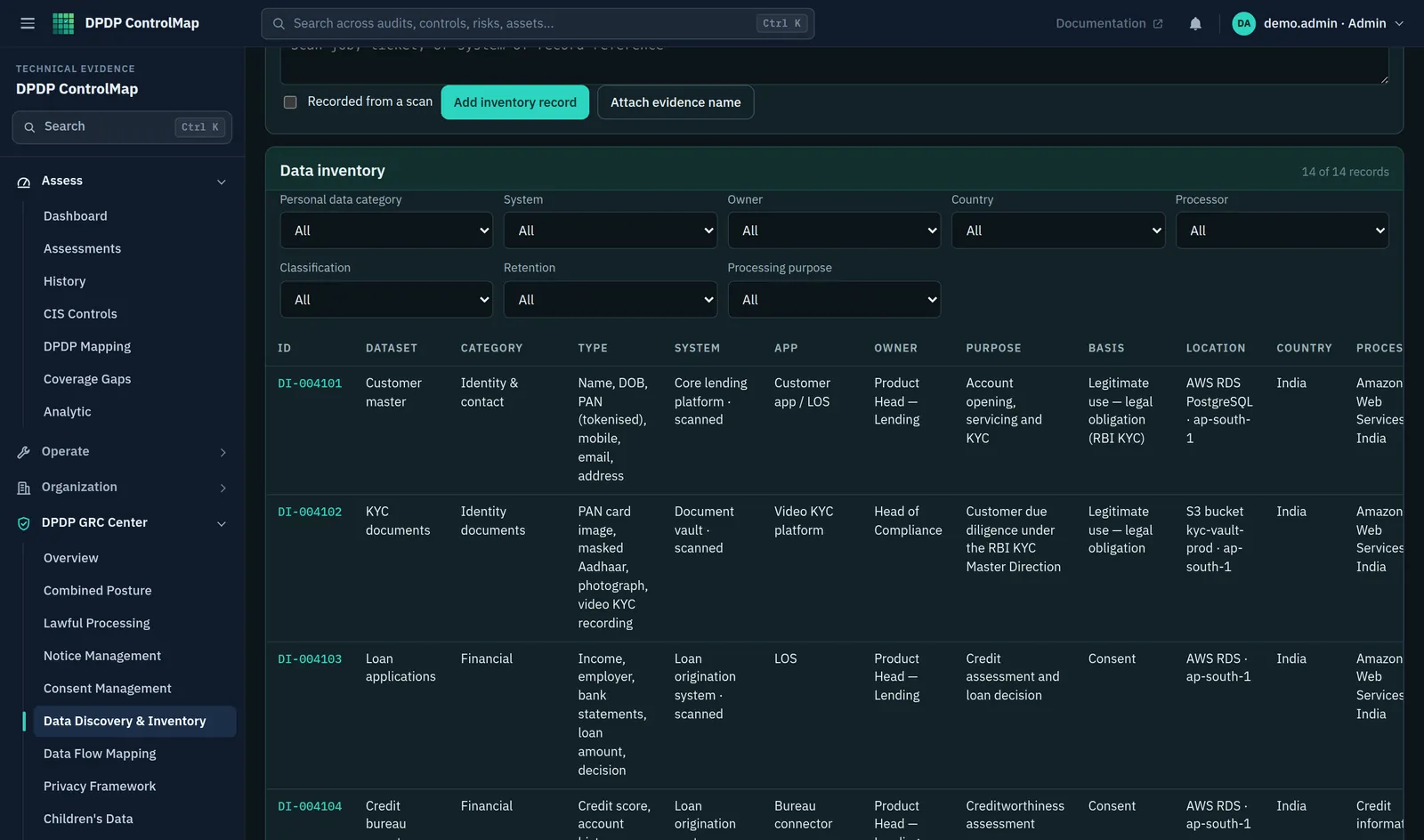
Record each programme's data
List the datasets each programme collects, where they are kept and who is responsible.
Mark children's data
Flag datasets that contain data about people under eighteen so the Section 9 controls are assessed against them.
Map what is shared
Record each flow of data to a funder, partner or service provider, with its purpose and basis.
Review notices and consent
Check that the notice describes the data and purpose, and record how consent is taken in the field.
Set retention and review it
Give each dataset a retention period and revisit it when a programme closes.
Recommended modules
A suggested place to begin
A suggested starting set. Every module shares the same inventory and control catalogue, so others can be added when you need them.
- Data InventoryOne register of programme, donor, volunteer and staff data.
- Data ClassificationChildren's data labelled consistently across datasets.
- Data Flow ManagementEach transfer to a funder or partner recorded and reviewed.
- Privacy NoticesNotices versioned and reviewed against Section 5 and Rule 3.
- Data Principal RightsRequests and grievances tracked to a response.
Implementation approach
Three phases, in your own time
The order matters more than the pace. How long each phase takes depends on how many systems you have and who is available to do the work.
- First
List programmes and data
Record what each programme collects, starting with those that involve children or the largest number of people.
- Next
Address children's data and sharing
Assess the Section 9 controls, and review every flow of data that leaves the organisation.
- Ongoing
Maintain with each programme cycle
Update the inventory when programmes start and close, and act on retention dates.
Benefits
What you have at the end
ControlMap supports the work of governance. Meeting the Act's requirements remains the responsibility of your organisation.
- Knowledge of what is held stays with the organisation when staff and volunteers change.
- Children's data is visible as such, wherever it sits.
- A record of what is shared, with whom and why, for funders who ask.
- A catalogue that separates what the Act requires from recommended practice.
See how ControlMap fits programme work.
We will walk through the modules on this page with the product's sample data and answer what they do and do not cover.