By sector · Healthcare
Patient data across hospitals, laboratories and platforms
Care depends on patient data moving between departments, laboratories, insurers and partners. ControlMap records those movements and the basis for each, so they can be reviewed.
Your role under the Act
Providers are usually Data Fiduciaries; their suppliers are often Data Processors
A hospital, clinic, laboratory or health platform that decides why and how patient data is processed is a Data Fiduciary. A laboratory or software supplier that processes data on a provider's behalf may be its Data Processor.
The Act does not create a separate category of health or sensitive personal data. All digital personal data is covered alike, though the volume and sensitivity of data is one factor the Central Government may weigh when notifying Significant Data Fiduciaries under Section 10.
Challenges
What makes this hard
Many clinical and administrative systems
Registration, records, laboratory, imaging, pharmacy and billing systems each hold part of the patient record.
Constant sharing
Data moves to laboratories, insurers, referral partners and service providers as part of ordinary care.
Emergencies
Care sometimes has to begin before anyone can be asked for consent.
Children as patients
Paediatric and maternity services process the data of people under eighteen every day.
Long retention under other laws
Records are kept for long periods for clinical and legal reasons that sit outside the DPDP framework.
A breach affects people directly
Exposure of health information can cause lasting harm, and the time to respond is short.
Relevant DPDP obligations
What the Act and the Rules say
These provisions are often relevant to healthcare. They are summaries. Sector regulation and professional rules on medical records are outside the scope of this page; the Act applies in addition to them.
Medical emergencies and public health
Among the certain legitimate uses are responding to a medical emergency involving a threat to life or an immediate threat to health, and providing medical treatment or health services during an epidemic, outbreak of disease or other threat to public health.
Children's data in clinical settings
For clinical establishments, mental health establishments and healthcare professionals, Sections 9(1) and 9(3) do not apply where processing is restricted to providing health services to the child, to the extent necessary for the protection of her health.
Processors under a valid contract
A Data Fiduciary may engage a Data Processor only under a valid contract, and stays responsible for the processing done on its behalf.
Reasonable security safeguards
Rule 6 lists the minimum safeguards, including measures such as encryption or masking, access control, logs and their review, backups and processor contract terms.
Breach intimation
Affected Data Principals are told without delay. The Board is told without delay, with detailed information within seventy-two hours of becoming aware, or a longer period the Board allows on written request.
Erasure, unless a law requires retention
Personal data is erased when consent is withdrawn or as soon as it is reasonable to assume the specified purpose is no longer being served, unless retention is necessary for compliance with any law for the time being in force.
Typical workflow
How the work usually runs
A sequence that follows how patient data actually moves.
Inventory by system
Record the datasets each clinical and administrative system holds, with owner, purpose and retention.
Map the sharing
Draw the flows to laboratories, insurers, partners and service providers, and note which are processors.
Record the basis for each activity
Note where processing rests on consent and where it rests on a certain legitimate use, with the reasoning.
Prepare for a breach
Assess the readiness controls: who decides, who is told, what an intimation must contain, and by when.
Handle requests
Track access, correction and erasure requests and grievances to a response.
Recommended modules
A suggested place to begin
A suggested starting set. Every module shares the same inventory and control catalogue, so others can be added when you need them.
- Data InventoryPatient, staff and visitor data recorded by system and owner.
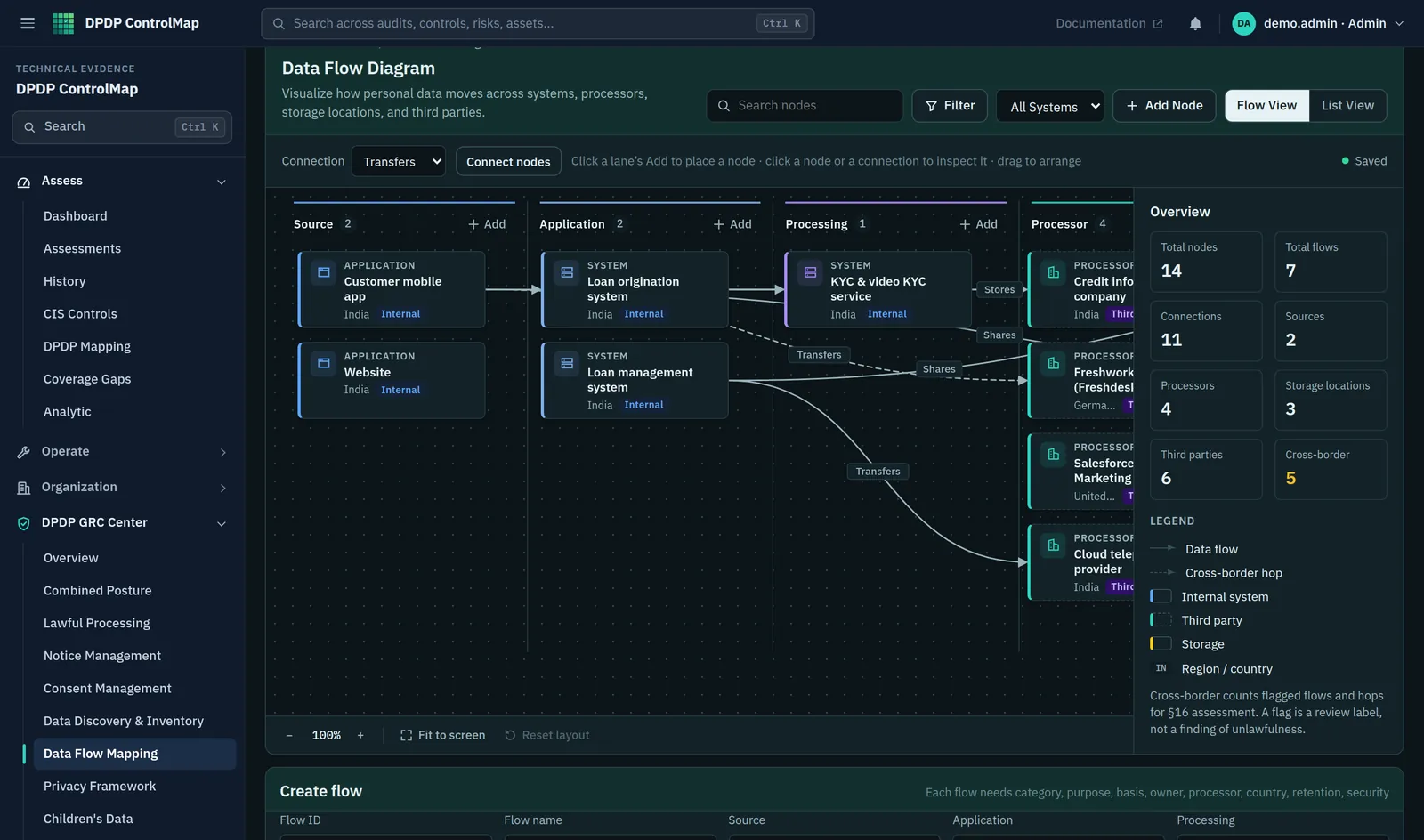
- Data MappingA diagram of how data moves from registration to third parties.
- Consent ManagementConsent records with purpose, notice version and withdrawal.
- Breach ManagementReadiness against Section 8(6) and Rule 7, and a log of incidents.
- Processor OversightLaboratories, software suppliers and other processors with their contracts.
Implementation approach
Three phases, in your own time
The order matters more than the pace. How long each phase takes depends on how many systems you have and who is available to do the work.
- First
Inventory the patient record
Start with the systems that hold the core patient record and the data shared most often.
- Next
Review sharing and breach readiness
Map flows to third parties, check processor contracts and assess the breach controls.
- Ongoing
Extend and maintain
Cover the remaining systems, and review the record when a system, supplier or service changes.
Benefits
What you have at the end
ControlMap supports the work of governance. Meeting the Act's requirements remains the responsibility of your organisation.
- One picture of where patient data sits and where it goes.
- The basis for each processing activity is written down, not assumed.
- Breach roles, contents and time limits are settled before an incident.
- Processors and their contract terms are visible in one place.
See ControlMap with healthcare data flows in mind.
We will walk through the modules on this page with the product's sample data and answer what they do and do not cover.