Privacy Operations · Data Principal Rights
Handle every rights request and grievance through to closure.
One register for access, correction, erasure, withdrawal, nomination and grievance requests, with defined stages, owners and due dates.
The problem
Requests arrive by email and are tracked from memory
A rights request touches several teams. Without a shared record, steps are skipped, identity is not verified, and nobody can say how long a response took.
- Requests reach support, legal and IT separately and are logged nowhere.
- The person's identity is not verified before data is released.
- The search for their data misses systems outside the main application.
- Grievances have no clock and no escalation.
What it does
Data Principal Rights in ControlMap
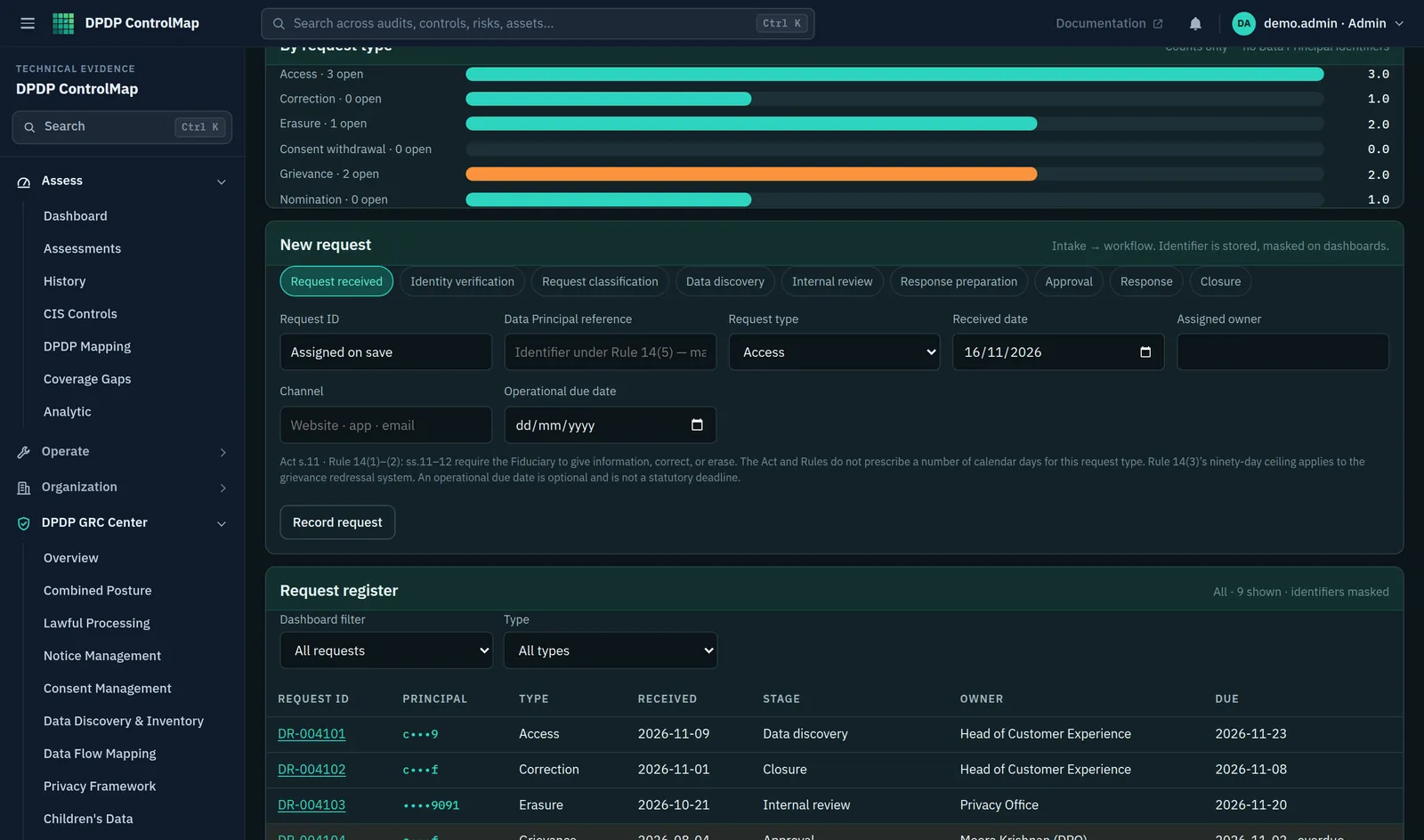
The module records each request with its type and moves it through nine stages: received, verify identity, classify, discovery, review, prepare response, approval, response and closed. Each request has an owner and a due date, and identifiers are masked in the register so that the tracking record does not itself expose personal data.
Grievances carry the period set by Rule 14(3). For other request types the due date is your own service standard. Nine controls assess whether intake, identity verification, retrieval, correction, erasure, grievance handling and nomination are in place.
Key capabilities
What you can do with it
Six request types
Access, correction, erasure, withdrawal of consent, grievance and nomination.
Nine stages
A defined path from receipt to closure, so every request is handled the same way.
Masked identifiers
The register shows a masked form of the requester's identifier.
Owners and due dates
Each request is assigned, and overdue requests are visible.
Grievance period
Grievances are tracked against the ninety-day ceiling in Rule 14(3).
Open requests by type
A summary of what is open, so workload and bottlenecks are clear.
In the product
The rights request register
Open requests, the request form and the register in one view.
- Open requests counted by type
- Workflow stages from request received to closure
- Masked identifiers, stage, owner and due date for each request
Typical workflow
How teams use it
A common sequence. The product does not force the order, and you can return to the earlier steps as you learn more.
Receive
Log the request, its type and the channel it arrived through.
Verify identity
Confirm the requester is the Data Principal or their nominee, using the identifiers you have published.
Find the data
Use the inventory to identify every system that holds the person's data.
Prepare and approve
Assemble the response or make the correction or erasure, and have it approved.
Respond and close
Send the response, record the date and close the request.
DPDP governance
How it supports your obligations
Chapter III of the Act gives Data Principals rights that a Data Fiduciary must be able to honour.
A Data Principal may obtain a summary of the personal data being processed and the processing activities, and the identities of other Data Fiduciaries and Data Processors with whom it has been shared.
Access requests follow a defined path that includes discovery across the inventory.
A Data Principal has the right to correction, completion, updating and erasure of personal data for which consent was given.
Correction and erasure are request types with their own controls.
A Data Fiduciary is to provide readily available means of grievance redressal and respond within the prescribed period. Rule 14(3) has it publish that period, which is to be reasonable and not exceed ninety days.
Grievances are logged, owned and tracked against that period.
A Data Principal may nominate another individual to exercise their rights in the event of death or incapacity.
Nomination is a request type, and a control assesses whether a mechanism exists.
Scope
What stays with you
We would rather you knew the boundaries before a demo than discovered them after.
- ControlMap tracks the request. It does not retrieve, correct or erase data in your other systems.
- There is no public-facing portal for Data Principals in the product today. Requests are logged by your team.
- Only the grievance period in Rule 14(3) is treated as a statutory limit. Other due dates are set by you.
Questions
Data Principal Rights: common questions
Is there a time limit for responding to an access request?
Rule 14(3) has a Data Fiduciary publish the period within which its grievance redressal system responds, which is to be reasonable and not exceed ninety days. For other requests, ControlMap lets you set your own due date and does not present it as a statutory deadline.
Can Data Principals submit requests directly?
Not through ControlMap today. Your team logs requests received through the channels you publish.
Why are identifiers masked?
A register of rights requests is itself personal data. Masking limits what is visible to those who only need to track progress.
See Data Principal Rights in a demo.
We will show the module with the product's sample data and answer what it does and does not cover.