By role under the Act · Data Fiduciaries

For organisations that decide why and how personal data is processed

The Act places its principal obligations on the Data Fiduciary. ControlMap organises those obligations into controls you can assess, evidence and keep under review.

Your role under the Act

The role that carries the obligations

A Data Fiduciary is any person who alone or in conjunction with other persons determines the purpose and means of processing of personal data (Section 2(i)).

The fiduciary answers for processing done on its behalf by a Data Processor (Section 8(1)). Engaging a processor moves the work, not the responsibility.

Guide: Data Fiduciary or Data Processor

Data Fiduciary

Section 2(i) Any person who alone or in conjunction with other persons determines the purpose and means of processing of personal data.

  • Answers for processing done by it or on its behalf by a Data Processor (Section 8(1)).
  • Gives notice and obtains consent, or relies on a certain legitimate use (Sections 4 to 7).
  • Takes reasonable security safeguards and intimates breaches (Sections 8(5) and 8(6)).
  • Responds to the rights and grievances of Data Principals (Sections 11 to 14).
Data Processor

Section 2(k) Any person who processes personal data on behalf of a Data Fiduciary.

  • Is engaged by a Data Fiduciary only under a valid contract (Section 8(2)).
  • Meets most of its duties through that contract; Chapter II is addressed to the fiduciary.
  • Has to be able to stop processing and erase data when the fiduciary is required to cause it (Sections 6(6) and 8(7)).
  • Is itself a Data Fiduciary for data it controls, such as its own employees' data.

Which role an organisation holds depends on the facts of each processing activity, and one organisation can hold both. If the answer is unclear, take legal advice.

Challenges

What makes this hard

  • Knowing every processing activity

    Obligations attach to each purpose for which data is processed, and few organisations have listed them all.

  • Showing that consent was valid

    If consent is questioned in a proceeding, the fiduciary has to prove that notice was given and consent obtained.

  • Answering for processors

    Safeguards, cessation and erasure have to reach every processor that holds the data.

  • Acting when consent ends

    Withdrawal has to stop processing in every system and at every processor, within a reasonable time.

  • Responding in time

    Rights requests, grievances and breach intimations all run against a clock.

  • Keeping it true

    A record that was accurate at launch drifts as systems, vendors and purposes change.

Relevant DPDP obligations

What the Act and the Rules say

The main duties of a Data Fiduciary, in summary. The DPDP Act page sets them out more fully with links to the official text.

Sections 4 to 7

A ground, a notice and valid consent

Process only for a lawful purpose with consent or for a certain legitimate use; give notice with every request for consent; and obtain consent that is free, specific, informed, unconditional and unambiguous.

Section 6(10)

Proof of notice and consent

Where consent is the basis of processing and a question arises in a proceeding, the Data Fiduciary is obliged to prove that notice was given and consent was obtained in accordance with the Act and the Rules.

Section 8(3) to 8(5) · Rule 6

Accuracy, measures and safeguards

Ensure completeness, accuracy and consistency where data is used for a decision or disclosed to another fiduciary; implement technical and organisational measures; and take reasonable security safeguards.

Section 8(6) · Rule 7

Breach intimation

Intimate the Board and each affected Data Principal of a personal data breach, in the form and manner the Rules prescribe.

Section 8(7) · Rule 8

Erasure and retention

Erase personal data when consent is withdrawn or the purpose is no longer served, and cause processors to do the same, unless retention is necessary for compliance with a law.

Sections 11 to 14 · Rule 14

Rights of Data Principals

Provide for access to information, correction and erasure, grievance redressal and nomination, and publish how those rights can be exercised.

These are summaries for orientation, not legal advice. Whether a provision applies to you depends on your facts. The DPDP Act page sets out the provisions more fully, says when each comes into force and links to the official text.

Typical workflow

How the work usually runs

The sequence the product is designed around.

  1. Discover and inventory

    Establish which systems hold personal data and record each dataset.

  2. Map processing and flows

    Record the purpose and basis of each activity and where the data travels.

  3. Assess against the catalogue

    Answer each control's question, and record implementation and evidence separately.

  4. Operate notices, consent and rights

    Version notices, follow consent through its lifecycle and track requests to a response.

  5. Remediate and review

    Assign findings, set due dates and revisit each control on its review date.

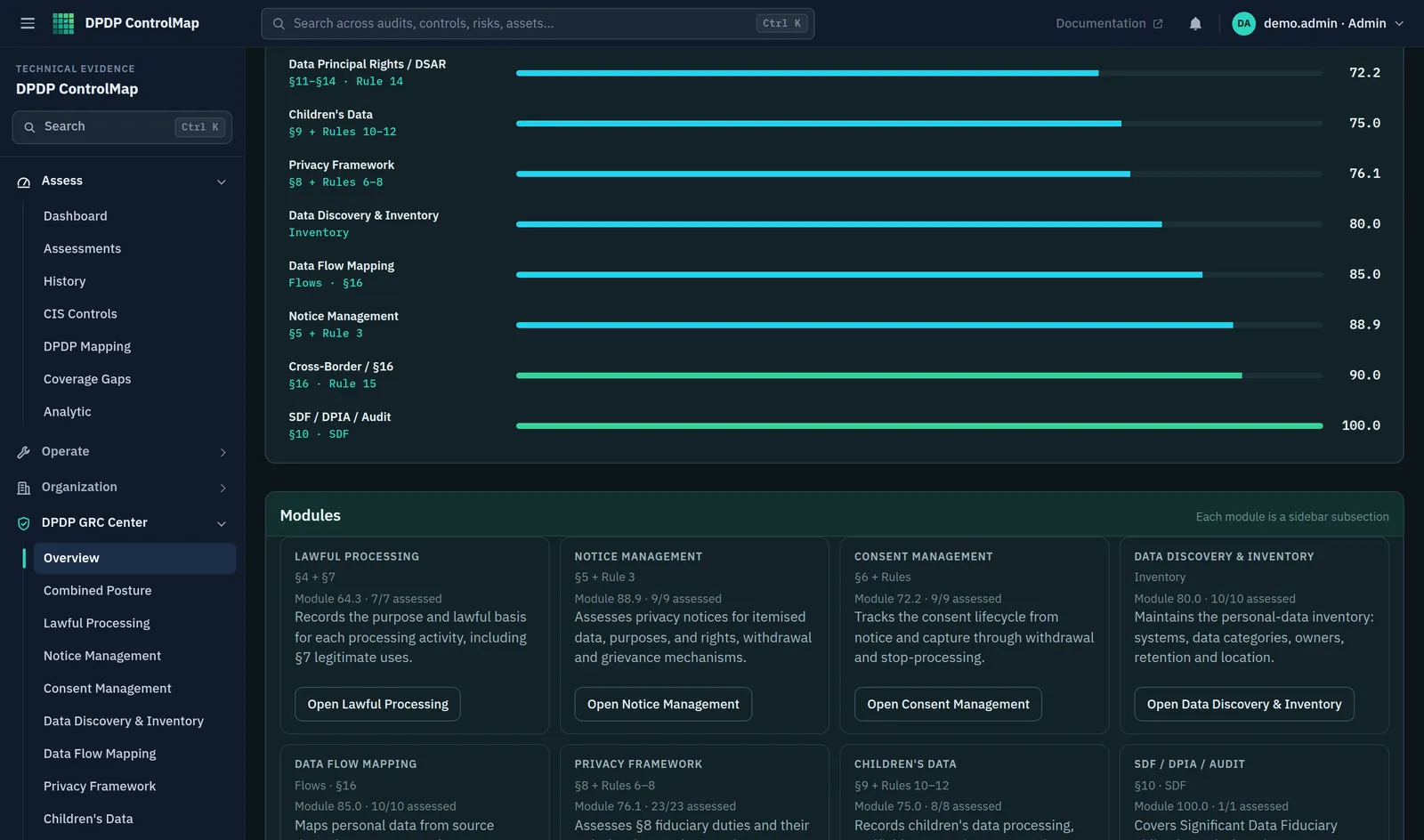
Module readiness bars followed by a card for each module, showing the Act sections it covers, how many controls are assessed and a button to open it.
Product screenshot. The organisation and records shown are sample data that ships with ControlMap.

Implementation approach

Three phases, in your own time

The order matters more than the pace. How long each phase takes depends on how many systems you have and who is available to do the work.

  1. First

    Establish the record

    Build the inventory, record the organisation profile and make a first assessment of every module.

  2. Next

    Put the operations in place

    Bring notices, consent, rights handling and breach readiness up to what the Act describes.

  3. Ongoing

    Review on a cycle

    Revisit controls on their review dates and whenever processing changes.

Benefits

What you have at the end

ControlMap supports the work of governance. Meeting the Act's requirements remains the responsibility of your organisation.

  • Obligations expressed as specific questions with a section or rule reference.
  • Statutory requirements kept distinct from recommended practice.
  • Evidence held against the control it supports.
  • A record of consent and notice to draw on if either is questioned.

See your obligations as assessed controls.

We will walk through the modules on this page with the product's sample data and answer what they do and do not cover.