By sector · Financial services
Customer data alongside sector regulation
Financial institutions already work under detailed regulation. ControlMap records what the DPDP framework adds, next to the security controls you already measure.
Your role under the Act
Institutions are usually Data Fiduciaries; outsourced providers are often Data Processors
A bank, lender, insurer or fintech company that decides why and how customer data is processed is a Data Fiduciary. A provider that processes data on its behalf under contract may be its Data Processor.
The Act is in addition to, and not in derogation of, any other law in force (Section 38). Requirements set by sector regulators continue to apply. This page does not describe them.
Challenges
What makes this hard
Onboarding and identity data
Identity verification collects detailed personal data from every customer, through several channels.
Retention set by other laws
Records have to be kept for periods fixed elsewhere, which has to be reconciled with the duty to erase.
Extensive outsourcing
Collections, customer support, cloud hosting and analytics all involve processors handling customer data.
Several legal bases at once
Some processing rests on consent, some on a legal obligation, and the difference is rarely written down per activity.
High volumes of requests
Large customer bases mean a steady stream of requests and grievances, each with a period for response.
Two kinds of assurance
Technical security is measured by one team and privacy governance by another, with no shared view.
Relevant DPDP obligations
What the Act and the Rules say
These provisions are often relevant to financial services. They are summaries; the full list is on the DPDP Act page.
Notice at the point of collection
A request for consent is accompanied or preceded by a notice. The Act illustrates this with a bank that collects personal data in a video-based customer identification process.
Disclosure required by law
Among the certain legitimate uses is fulfilling an obligation under any law in force in India to disclose information to the State or its instrumentalities.
Erasure, unless a law requires retention
Data is erased when consent is withdrawn or the purpose is no longer served, unless retention is necessary for compliance with a law. The Act illustrates this with a bank that must keep client identity records for a period set by the law that applies to banks.
Loan defaults
Chapter II (other than Sections 8(1) and 8(5)), Chapter III and Section 16 do not apply to processing for ascertaining the financial information, assets and liabilities of a person who has defaulted on a loan or advance from a financial institution, subject to other law on disclosure.
Safeguards and breach intimation
Reasonable security safeguards are required, and on a personal data breach the Board and each affected Data Principal are intimated.
Transfers outside India
The Central Government may restrict transfers by notification. Any other law that provides a higher degree of protection or restriction on transfer continues to apply.
Typical workflow
How the work usually runs
A sequence that sits beside existing risk and audit processes.
Inventory customer data by product
Record datasets for each product line and channel, with owner, purpose and retention period.
Record the basis for each activity
Note whether processing rests on consent or on a certain legitimate use, and keep the reasoning.
Review processors and transfers
List each processor with its contract reference, and review flows that leave India.
Assess the controls
Score implementation and evidence separately for each control, with an owner and reviewer.
View governance beside technical readiness
Read control readiness next to technical control alignment from configuration checks, in one view.
Recommended modules
A suggested place to begin
A suggested starting set. Every module shares the same inventory and control catalogue, so others can be added when you need them.
- Data InventoryCustomer data recorded by product, system and owner.
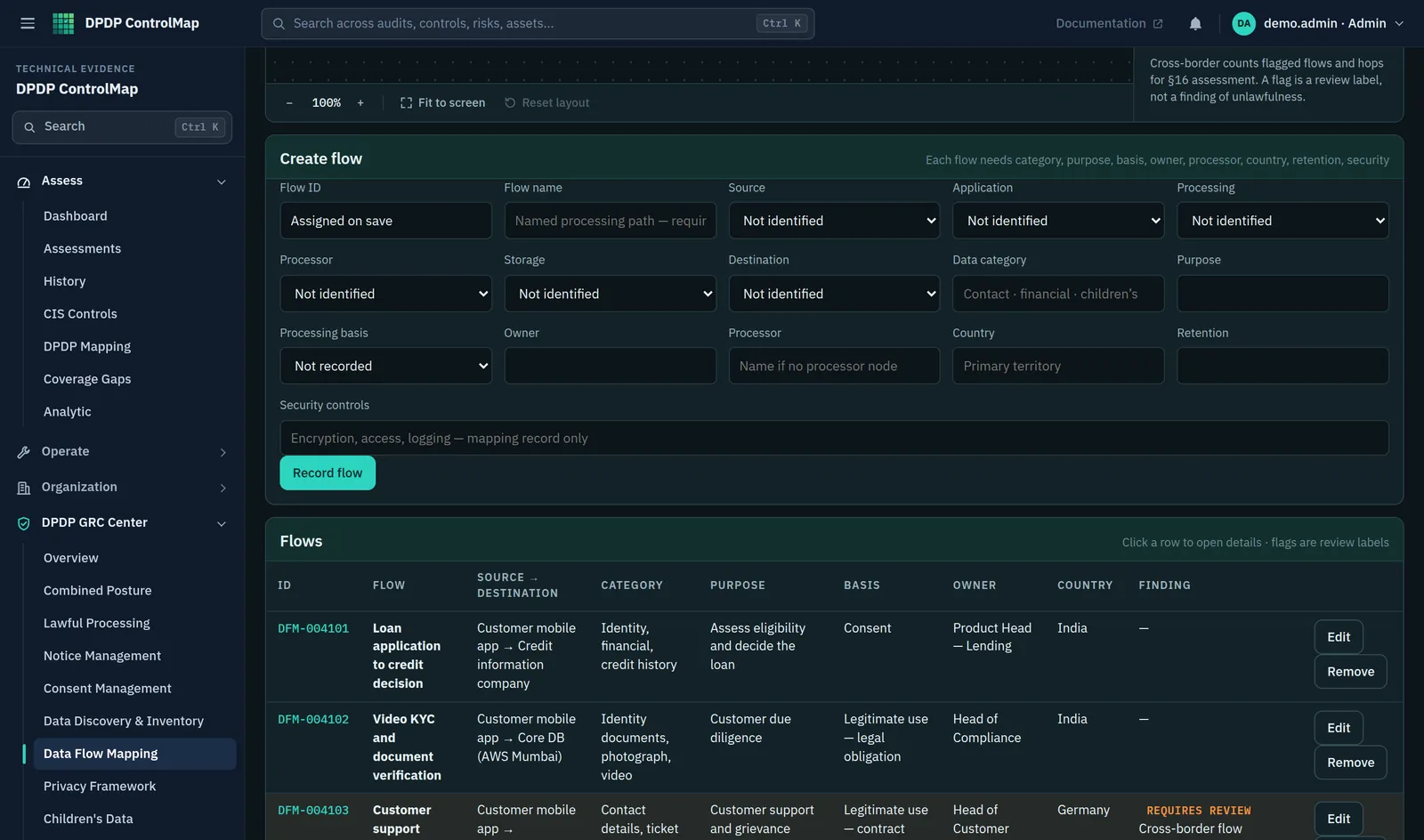
- Data Flow ManagementEach flow reviewed for basis, processor and country.
- Consent ManagementConsent followed from notice to withdrawal and stop.
- Processor OversightOutsourced providers, their contracts and safeguards.
- Audit ManagementAn append-only record of assessments and changes.
Implementation approach
Three phases, in your own time
The order matters more than the pace. How long each phase takes depends on how many systems you have and who is available to do the work.
- First
Scope by product line
Start with the products that hold the most customer data, and record the inventory and basis for each.
- Next
Processors, transfers and evidence
Review outsourcing arrangements and cross-border flows, and attach evidence to the assessed controls.
- Ongoing
Operate with existing governance
Fold the review cycle into existing risk and audit calendars, and report from the live record.
Benefits
What you have at the end
ControlMap supports the work of governance. Meeting the Act's requirements remains the responsibility of your organisation.
- The basis for each processing activity is recorded and reviewable.
- Retention periods sit beside the reason for them.
- Governance readiness and technical readiness are shown side by side, with the weighting between them visible.
- An append-only audit log of who changed what.
See ControlMap beside your existing governance.
We will walk through the modules on this page with the product's sample data and answer what they do and do not cover.