By organisation · Small and medium businesses
A structured start, without a dedicated privacy team
Most smaller businesses know they hold personal data and are unsure what the Act expects of them. ControlMap turns that into a list of specific things to check, each with its reference.
Your role under the Act
A Data Fiduciary, whatever the size of the business
A business that decides why and how it collects customer or employee data is a Data Fiduciary. The Act does not set a general exemption for small businesses.
Section 17(3) allows the Central Government to notify certain Data Fiduciaries or classes of them, including startups, to whom some provisions will not apply. Check whether a notification covers your business. Do not assume one does.
Challenges
What makes this hard
No one owns privacy
The work falls to a founder, an operations lead or an IT administrator, alongside everything else.
Data spread across tools
Customer data sits in a CRM, a helpdesk, spreadsheets and payment tools that nobody has listed in one place.
A notice copied from elsewhere
The privacy notice came from a template and does not describe what the business actually collects or why.
Vendors chosen for convenience
Service providers handle customer data under standard terms that were never read with data protection in mind.
No clear first step
The Act is short, but turning it into a work plan without help is hard.
Questions from larger customers
Enterprise customers send data protection questionnaires that take days to answer from memory.
Relevant DPDP obligations
What the Act and the Rules say
These provisions apply to Data Fiduciaries generally. They are summaries; the full list is on the DPDP Act page.
A ground for processing
Personal data may be processed only for a lawful purpose, either with the consent of the Data Principal or for one of the certain legitimate uses in Section 7.
A notice with every request for consent
The notice is to be understandable on its own and to set out, in clear and plain language, an itemised description of the personal data and the specified purpose of the processing.
Consent that can be withdrawn
Consent is to be free, specific, informed, unconditional and unambiguous, with a clear affirmative action. Withdrawing it is to be as easy as giving it.
Reasonable security safeguards
Personal data is to be protected by reasonable security safeguards, including for processing carried out by a Data Processor.
Breach intimation
On a personal data breach, the Data Fiduciary intimates the Board and each affected Data Principal.
A contact and a grievance mechanism
The business publishes the contact information of a person who can answer questions about processing, and keeps an effective mechanism to redress grievances.
Typical workflow
How the work usually runs
A sequence that works for a small team with limited time.
List what you hold
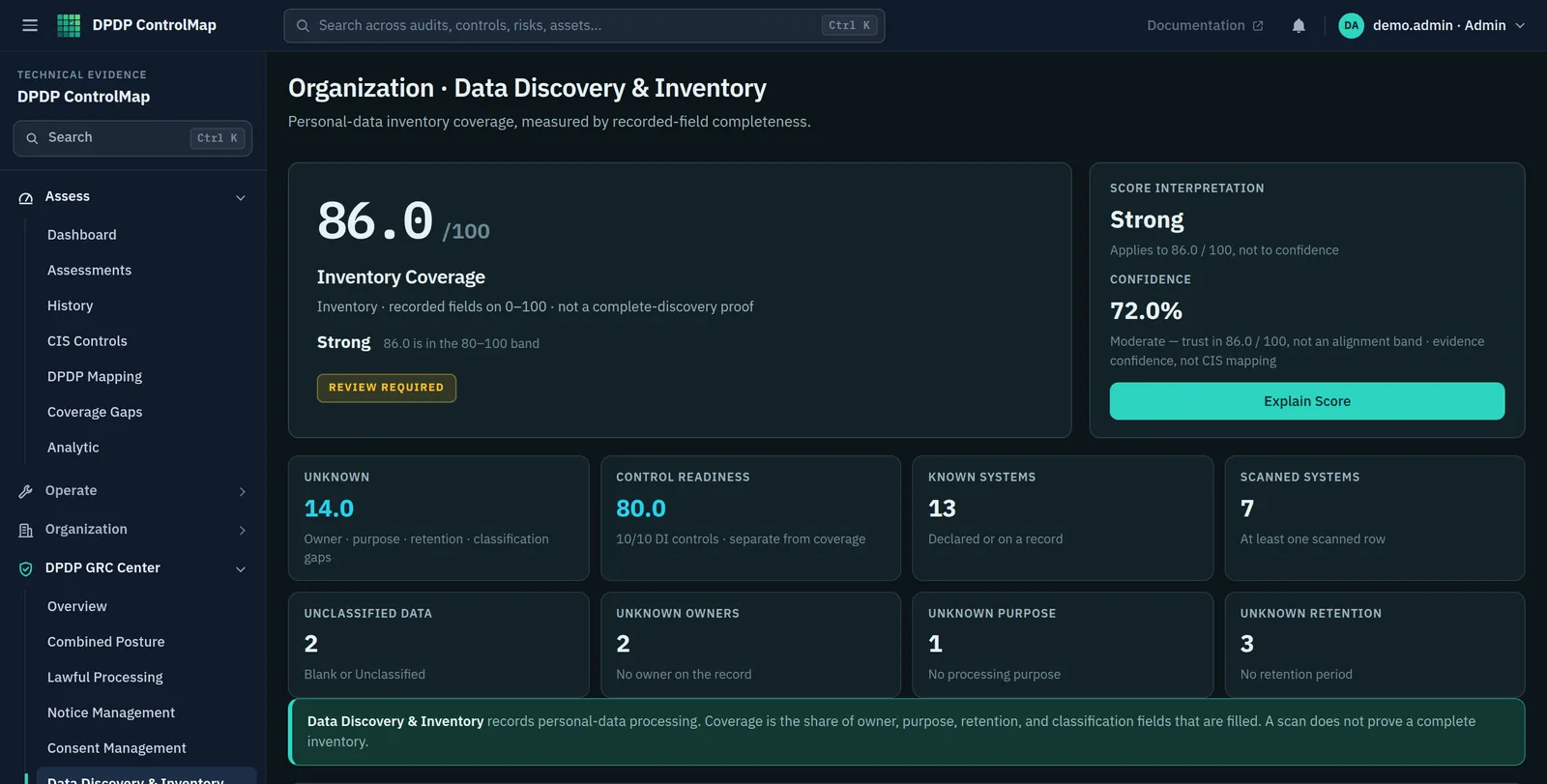
Record each dataset, the system it sits in and who looks after it. The coverage score shows how much is still unknown.
Write down why
Give each dataset a purpose, a processing basis and a retention period.
Review what people see
Check the notice against Section 5 and Rule 3, and record how consent is asked for and withdrawn.
Work through the controls
Answer the catalogue's questions one module at a time and note what evidence exists.
Track what is open
Give each finding an owner and a due date, and close it when the work is done.
Recommended modules
A suggested place to begin
A suggested starting set. Every module shares the same inventory and control catalogue, so others can be added when you need them.
- Data InventoryThe starting point: what you hold, where, and why.
- Privacy NoticesA notice reviewed against each element of Section 5 and Rule 3.
- Consent ManagementConsent records with their purpose, notice version and withdrawal.
- Data Principal RightsA register for access, correction, erasure and grievance requests.
- Breach ManagementReadiness controls and an incident log, in place before they are needed.
Implementation approach
Three phases, in your own time
The order matters more than the pace. How long each phase takes depends on how many systems you have and who is available to do the work.
- First
Know what you hold
Build the inventory for the systems that hold customer and employee data, and name an owner for each.
- Next
Fix what Data Principals see
Bring the notice, the consent request, the published contact and the grievance route into line with the Act.
- Ongoing
Assess and maintain
Work through the remaining controls, record evidence, and review the record when systems or vendors change.
Benefits
What you have at the end
ControlMap supports the work of governance. Meeting the Act's requirements remains the responsibility of your organisation.
- A defined place to start, and an order in which to continue.
- Each question carries its section or rule, so you can read the source yourself.
- Work is split into small items that can be assigned and closed.
- A current record to answer from when a customer or partner asks how you handle personal data.
See where a smaller business would begin.
We will walk through the modules on this page with the product's sample data and answer what they do and do not cover.